Showing posts with label inquiry. Show all posts

Wednesday, April 4, 2012

Technology (of a sort) in the Art Room

Pin It
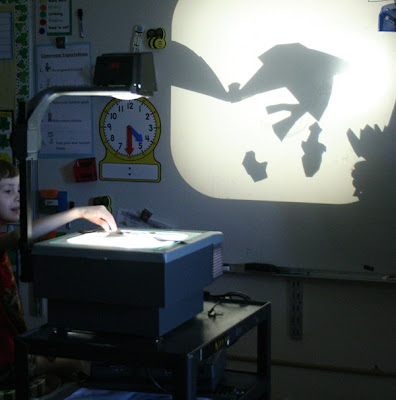
I recently made great strides in technology integration in my classroom...my first grade students spent three weeks of art classes using my extra special, super duper SHADOW MACHINE.... AKA an Overhead Projector!!  Yes, I know, it's overwhelmingly impressive.  As an art-on-a-cart teacher for this year, I have to be creative on how I meet that technology standard...


Joking aside, first graders recently learned about the solar system and the rotation of the earth in their science classes.  It turned out that this coincided perfectly with art lessons about Shadows.  We talked a bit about how artists make shadows using color and elongated shapes.  We looked at Wayne Thiebaud paintings.  After discussion we made the distinction that shadows in a painting or drawing are basically pretend.  Before we delve into how artists do that, we spent several weeks having a whole lot of fun making REAL shadows.  I was totally shocked at how well students did with this.  Each class took a different approach.  Not knowing how this would go over, I wanted to keep the lesson somewhat fluid to adapt to students' interests and the direction they wanted to take.  When all was said and done, the results were amazing.  My plain old overhead became a stage for many simple though exciting little tales made from paper cut outs that students presented in "Shadow Shows" at the end of the lesson.  One of my favorites depicted a student's own version of Chicken Little. His version involved an alien ship zooming in and stealing the sun.  Chicken Little stormed the ship, retrieved the sun, and put it back where it belongs.  Quite an amazing adventure.  Needless to say, there were also many monsters getting their heads torn off, etc.  As always, I saw the usually range of results.  Some students definitely got into the presentation part of this more than others, but as far as the process of translating a piece of paper into a paper cut out and finally into a shadow on a screen was rewarding to ALL students at ALL levels of ability.



Sunday, February 5, 2012

Lights, Art Class, Action!

Pin It
One of my first grade classes is especially curious, and their teacher is very good at drawing this out of them and following their inquiries.  Lately, I've been lucky enough to join them on some of these adventures.  In their classroom reading time, they noticed an illustration in a book that depicted two people walking through the forest at night with a flashlight.  They were very curious about how the artist created the illusion of the flashlight shining in the darkness.  When I came to their classroom for art that week, they bombarded me with excited questions--"How did they do this?  Can you show us?  Can we try it?"  As a teacher who is always happy to let my students plan lessons for me, this launched several weeks of exploration in art class   Each class approached the challenge in different ways.  (Teaching lessons in the same exact way for 8 sections of first grade gets a little boring.)  The one similarity was that we read the same book--"Black Out" by John Rocco.  The challenge was the same as well--create the illusion of light in darkness using warm/cold colors.  This concept was an extension from their previous project of Warm Inside/Cold Outside paintings.

 One class made small scale collages working with different kinds of papers and practicing layering to create depth.  They were each given a 6"x9" piece of paper for a background.  It was really nice to have them work small--I tend to let them always work big, but the change to a small scale project was refreshing.  They also had to really focus on the goals of the project--lights and layering. 


Two other classes were given more freedom to choose their own materials and subject matter. They met the goals of the project and they were also able to use previous knowledge about composition and materials used in prior lessons.